


Send a fundraising email and, on a good day, one in five people opens it. Send a text message and almost everyone reads it — usually within minutes. That single gap explains why text message fundraising has quietly become the most effective way for sports teams to raise money.
But “text message fundraising” covers a few very different methods, and they don’t all work equally well for a team. This guide breaks down what text-based fundraising actually is, why it outperforms email and social media, and how sports programs use it to raise anywhere from $10,000 to $70,000 in a single hour.
What is text message fundraising?
Text message fundraising is any method that uses SMS to solicit and collect donations. Instead of relying on email blasts, social media posts, or door-to-door sales, the ask arrives directly in the one inbox almost everyone checks: their text messages.
There are three main flavors, and the differences matter for teams.
Text-to-give (keyword and shortcode)
The classic nonprofit model: a donor texts a keyword to a short number, then receives a link to complete their donation. You’ve seen it during telethons and at charity events.
It works well for large organizations broadcasting to a big audience, but it’s passive — you’re waiting for people to see a prompt and act. For a sports team with a defined roster and network, it usually underperforms a direct approach.
Peer-to-peer text fundraising
Here the athletes do the texting. Each player sends personal messages to people they actually know — family, family friends, former coaches, neighbors — asking for support. Because the message comes from someone the recipient cares about, response rates jump dramatically compared to an anonymous broadcast.
This is where sports teams have a structural advantage, and we’ll come back to why.
The text-and-call hybrid
The highest-converting version adds one step: after the text goes out, the athlete follows up with a quick phone call. The text warms the contact up; the call closes the donation. That combination — a personal text plus a live voice — is the core of the Hour-A-Thon model, and it consistently outperforms text alone.
Why text beats email and social media for fundraising
The advantage isn’t a matter of opinion — it comes down to how each channel actually gets consumed.
- Texts get read. Industry figures commonly report SMS open rates in the 95–98% range, with most messages read within minutes. Email open rates typically hover around 20%. A message no one opens can’t raise money.
- Texts get read fast. Email can sit unopened for days; a text is usually seen almost immediately. That speed is exactly what a time-boxed fundraiser needs.
- Texts feel personal. A text lands in the same place as messages from family and friends — not a promotions tab, not an algorithmic feed. There’s no spam folder deciding whether the ask gets seen.
- Social media reaches the wrong people. A Facebook post reaches whoever the algorithm decides, whenever it decides. A text reaches the specific person the athlete chose, right now.
One honest caveat on the numbers: the widely cited 98% open rate is an industry estimate, not a precisely measured figure — SMS has no tracking pixel the way email does. But even the conservative end of the range dwarfs email, and every study points the same direction.
Why sports teams are perfect for text fundraising
Plenty of organizations can send texts. Sports teams have three things that make text fundraising work unusually well:
- Athletes have real, motivated networks. Every player has grandparents, aunts, uncles, and family friends who genuinely want to support them. That’s a warm audience most nonprofits would kill for — and it multiplies by every athlete on the roster.
- A personal ask from a kid converts. “Support my team” from a young athlete lands very differently than a generic org blast. People give to people, especially young people they know.
- Teams can act in unison. Get the whole roster texting at the same time and you create momentum and a little friendly competition — which is exactly how a one-hour event generates outsized results.
Stack those together and a 40-player team can reach a thousand motivated supporters in an afternoon — without buying an ad, printing a flyer, or selling a thing.
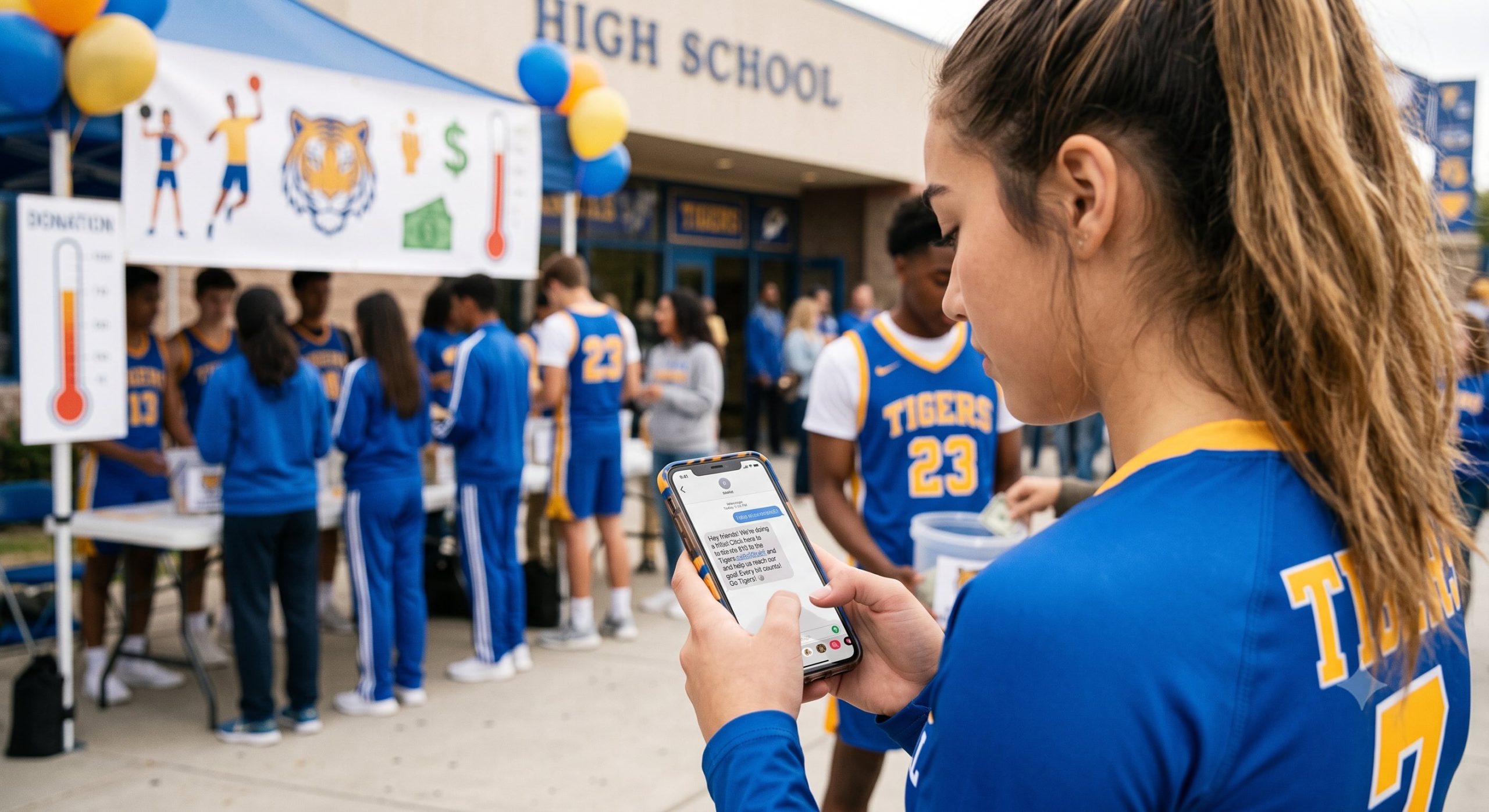
How a text message fundraiser actually works, step by step
A well-run text fundraiser follows a simple sequence:
- Each athlete builds a contact list beforehand. Around 25 people who might support them — relatives, family friends, former coaches, neighbors. Not teammates, and not strangers.
- The team sends texts together, in one window. A short, personal message goes out to each contact with a direct donation link. Doing it as a group creates energy and keeps everyone on task.
- Athletes follow up with a call. A quick phone call after the text is what turns “I’ll get to it later” into a donation made on the spot. This step is the single biggest lever on results.
- The donation window stays open briefly. Leaving the link live for about a week catches contacts who missed the first message.
- Funds are collected and paid out. With a managed platform, money is processed and delivered to the program within a couple of days.
That’s the entire model. The heavy lifting happens in a single concentrated hour.
What a good fundraising text looks like
The message matters. A strong fundraising text is short, personal, and specific. It names the athlete, states the goal, and makes the ask easy. Something like:
“Hi Aunt Carol, it’s Jordan! My soccer team is fundraising today to cover tournament travel this season. Would you be willing to chip in? Here’s the link — anything helps, and thank you so much! [link]”
What makes it work: it’s clearly from a real person, it explains where the money goes, it keeps the ask low-pressure, and the link removes any friction. Avoid long paragraphs, avoid guilt, and never send an identical mass blast — the personal touch is the whole point.
One rule you can’t skip: only text people who know the athlete
Text fundraising works precisely because it’s personal — and staying personal also keeps you on the right side of texting etiquette and the law.
Athletes should only contact people they have a genuine relationship with — family and friends who won’t be surprised to hear from them. Don’t buy phone number lists, don’t blast strangers, and don’t scrape contacts. Beyond being ineffective, unsolicited mass texting can run afoul of consumer protection rules. The good news is that the most effective approach and the most compliant approach are the same one: real people texting people they actually know.
What sports teams raise with text fundraising
The results speak for themselves. Here’s what real programs have raised using a one-hour text-and-call model:
- Pearland HS Football — $71,290 from 1,391 donors
- Erskine College Athletics — $123,440 from 1,543 donors
- Lander University Athletics — $197,198 from 610 student-athletes (about $323 each)
- Florida Kraze Krush Club Soccer — $154,000+ from 2,577 donors at a $60 average donation
- Del Oro Wrestling — $13,287 from 220 donors in a single hour
The pattern holds across sports, school levels, and program sizes: text plus a follow-up call, done by the whole team at once, raises real money fast.
See what your team could raise →
Frequently asked questions
How does text message fundraising work?
Participants send personal text messages containing a donation link to people in their network, then often follow up with a phone call to complete the donation. Because texts are read far more often and faster than email, and because the ask comes from someone the recipient knows, response rates are high. For sports teams, the whole roster typically does this together in a single one-hour event.
Is text fundraising better than email for sports teams?
For most teams, yes. Email open rates average around 20%, while text messages are commonly reported to be opened at 95–98% and read within minutes. Since a fundraising message only works if it’s actually seen, text’s reach advantage translates directly into more donations.
Do athletes need their own phones to participate?
No. Younger players who don’t have a phone can sit with a parent and send the texts and make the calls together. In practice, younger age groups often perform very well, because relatives respond strongly to hearing directly from the child.
Is text message fundraising legal?
Yes, when done correctly. The key is that athletes contact only people they have a real relationship with, rather than blasting purchased or random numbers. Personal outreach to family and friends is both the most effective and the most compliant approach. Avoid mass-texting strangers.
How much can a team raise with a text fundraiser?
A useful planning figure is $200–$300 per participating athlete. That puts a 40-player team in the $8,000–$15,000 range, while full clubs and college departments running large rosters have raised well into six figures.
How is text-and-call different from plain text-to-give?
Text-to-give waits for donors to text a keyword and act on their own. Text-and-call is active: the athlete sends a personal text and then calls to follow up, which converts far more of those contacts into actual donations. The live voice is what closes the gift.
The bottom line
Text message fundraising works because it meets people where they already are — the one inbox they actually check. For sports teams, that advantage compounds: every athlete brings a network of people who genuinely want to help, and a single hour of personal texts and calls turns that goodwill into real funding.
No selling. No month-long campaign. Just your team, one hour, and the people who already believe in them.
Run a text-and-call fundraiser for your team →
Want to go deeper? Learn why the one-hour model works, see real results from teams, or browse fundraising ideas for youth sports, lacrosse, and wrestling.

Share This Story, Choose Your Platform!

About the Author:
Michael Braunstein
is a fundraising expert and founder of Hour-A-Thon.


